Jul 11, 2015

Local Integration of Somali refugees, a workable option that Kenya refuses to consider

There are over a half a million refugees in Kenya, trapped in protracted refugee situations with few opportunities for self-reliance. In Dadaab refugee camp, some Somali refugees have stayed for as long as 25 years. Their prolonged stay is not in any way illegal but it should be a concern to all that ought to find durable solutions for them.

A tripartite agreement signed in 2013 by UNHCR and the governments of Kenya and Somalia set out a framework for voluntary repatriation of Somali refugees willing to return home. Voluntary repatriation being one of the durable solutions for refugee situations, it is expected that a few Somalis if not all, will voluntarily return home.


The other two durable options acceptable internationally are resettlement to third countries and local integration.


Resettlement depends on quotas decided upon by donor countries. It is often not a reliable solution for majority because slots are reserved for vulnerable cases particularly refugees with more serious protection concerns.
 
Local integration on the other hand allows refugees to attain a wider range of rights including acquisition of citizenship in their country of asylum. It is also a social and cultural process of adaptation and acceptance that can enable refugees to contribute to the social and economic life of their asylum country.


Somali refugees in Dadaab share cultural similarities with local Kenyans who are also Somalis. The two have the same origins and have peacefully lived together for over 20 years. The mare fact that they speak the same language with locals and have even intermarried, should be inspiring enough to have them locally integrated, shall they choose not to return home.


The principle of local integration is firmly established in international refugee law. The 1951 UN Refugee Convention acknowledges the role of local integration and the importance of citizenship in achieving durable solutions for refugees.


According to article 34 of the Convention, “the contracting states shall as far as possible facilitate the assimilation and naturalization of refugees. They shall in particular make every effort to expedite naturalization proceedings.”


Kenya is party to the 1951 UN Convention relating to the status of refugees, the 1967 Protocol and the 1969 Organization of African Union Convention governing specific aspects of refugee problems in Africa. In fact, article 2 (6) of the 2010 Constitution of Kenya states that any international convention or treaty will become a part of the Kenyan law. The provisions within these conventions are therefore part of the national law.


It is therefore in Kenya’s best interest under its international obligation, to establish what it can contribute towards finding durable solutions for these refugees. Currently, the Refugees Act, 2006 through an encampment policy does not allow refugees to live outside designated areas. It demands that all refugees should stay in camps at all times unless traveling to seek education or medical treatment.


The sudden enforcement of the refugee encampment policy in 2014 which was strengthened by the controversial amendment to the security act has had an unpleasant impact on refugees who had for many years established themselves in urban areas. The enforcement prompted ‘Usalama’ watch and cracking down of refugees in their urban settlements. 

This was however largely criticized by the civil society as a violation of human rights.

Considering this and other concerns, there should be a discussion on what workable solution for Kenya’s refugee situation that has not been tried yet.


If Somali refugees who have stayed in Kenya for over fifteen years, and are not willing to return home were to be locally integrated, Kenya would possibly benefit in a number of ways:


De-congestion of Dadaab refugee camp will be the immediate benefit. This will create space for environmental rehabilitation in severely degraded sites within and around the camp. It will also make it easy for authorities to manage camps and monitor activities across the Kenya Somalia boarder which is claimed to be porous.


Locally integrated refugees will become Kenyan citizens and will begin contributing to Kenya’s economy. They may not necessarily be allocated land but they will constitute a new labor force with skills that can be utilized to benefit villages in which they shall settle.


With carefully planned integration, Kenya may generally benefit from long term donor supported infrastructural development. In other words, a huge chunk of aid currently directed to refugee camps will be made available in Kenyan villages for development.


It will also have an additional appeal for Kenya as a human rights defender. Freedom of movement and the right to work are two fundamental human rights that are often denied to refugees confined in camps.


With political will, the process of local integration can be smooth. African countries including Angola, Guinea, Gabon, Namibia, Sierra Leone, Ivory Coast, Tanzania, Uganda and Zambia have within the last four decades locally integrated refugees successfully.


In 1981, Tanzania granted citizenship to approximately 25,000 Rwandese refugees. In 2003, it declared settlement and free movement for approximately 3,000 Somali refugees with the possibility of local integration. More recently in 2014, over 162,000 Burundi refugees were all granted citizenship.


Kenya has a good opportunity to formulate a new legal framework within which the process of local integration of refugees can be anchored. Perhaps the new proposed amendment bill to the Refugee Act, 2006 that has been under review since 2011 can be ridden upon.

Jan 25, 2015

Shikley ML - Its what she is!


Young smart she be, unassuming demure mellow she,
Amazing smile she’s got, makes everything seem alright,
From the moon life she views, bright and slow comes as she,
Collected calmly as cool, abiding in her is alright.

How I wish I could let mama know, what a beloved she bore,
Even though I'm a little slow, to her damsel I bow.
For honesty she exudes, down to her hips,
You see what you hear, right from her lips.
 
A pretty Sheeky she, 'hang in there' she ought,
Listen to witty she, a mare hot she is not,
A year you know some, you don’t see what they be,
A week you know Shee, a sweet rock and roller she be.


Nov 21, 2014

UNHCR seeks to reassure refugees in Kenya facing food shortages

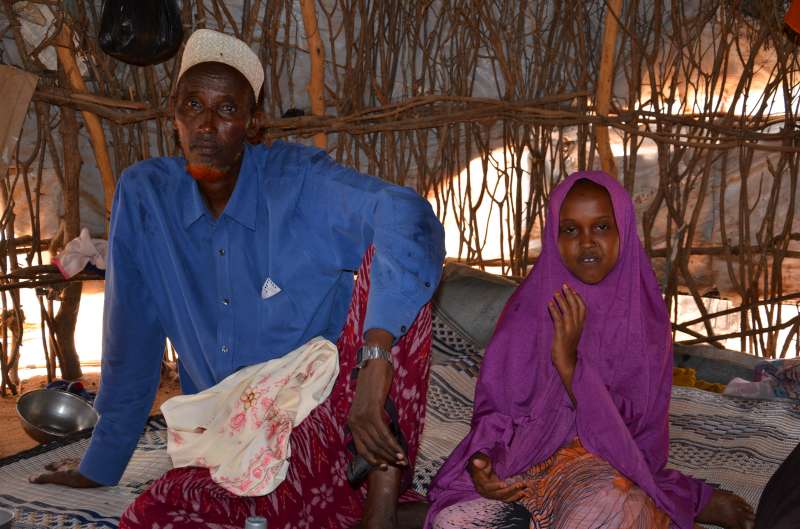
Hussein Farah and one of his 10 children sit in the shade of their shelter in Dagahaley refugee camp, Dadaab. He says it is tough to feed his children, even with full rations.© UNHCR/D.Mwancha 


NAIROBI, Kenya, November 21 (UNHCR) The UN refugee agency has sought to allay the concerns of hundreds of thousands of refugees facing food ration cuts in northern Kenya and stressed that these are not linked to the repatriation of Somalis.


"We call for calm in camps. The reduction of food rations is purely as a result of funding constraints and should not in any way be linked to the planned pilot project that will support refugees spontaneously returning to Somalia," Raouf Mazou, UNHCR's representative in Kenya, said in Nairobi this week.


He also stressed that UNHCR and the World Food Programme (WFP) were working together around the clock to resolve the food problem for a total 490,000 refugees in Kakuma and Dadaab camps. "We did not expect that we would reach this point but we are making frantic efforts with our partners to secure additional funds," he said.


WFP on Friday said it was halving bimonthly food rations from now until the end of January for refugees in Kakuma (mainly South Sudanese) and Dadaab (mainly Somalis). The UN agency said this was because it needed an extra US$38 million to ensure regular rations for the refugees over the next six months.


The announcement came some six months after UNHCR and WFP announced in July that some 800,000 refugees in Africa were on reduced rations because of funding shortages. They asked donors for US$186 million to allow WFP to restore full rations and prevent further cuts, and for UNHCR to provide nutritional support.


Many of the refugees are concerned about the food cuts. "For some of us who do not get any remittances from relatives abroad, it is tough to raise children, even with the full monthly ration. I wonder how tough it will be with cuts," said Hussein Farah, a father of 10 in Dagahaley, one of Dadaab's refugee camps.


Others in Dadaab feared a link with the project to support spontaneous returns to Somalia. In November last year, UNHCR and the governments of Kenya and Somalia agreed on a legal framework for the voluntary return of Somali refugees in Kenya. There is no deadline in the agreement for the return of refugees and the implementation of voluntary return has focused on the pilot project supporting refugees who are spontaneously returning to Somalia.


By the end of October, 3,231 refugees had presented themselves at help desks in Dadaab refugee camps and asked about return. Among these, about 2,500 are targeted for return assistance.

Oct 9, 2014

Innovation: UNHCR and Vodafone bring tablet-based learning to 18,000 Somali refugees


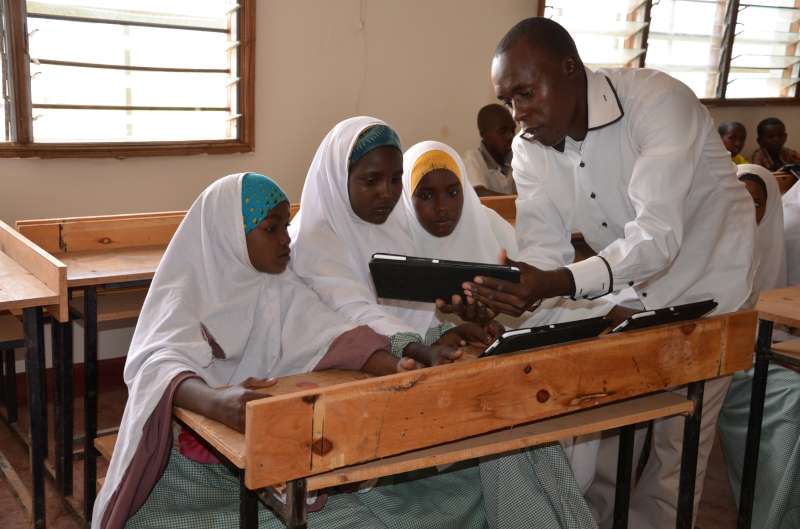
Michael Mutinda, a teacher in one of Dadaab's primary schools shows his pupils how a tablet computer works. © UNHCR/D.Mwancha
 

DADAAB, Kenya, October 9 (UNHCR) The UN refugee agency and the Vodafone Foundation have this month opened centres equipped with mobile technology that will allow thousands of young Somalis to complement, supplement and further their studies in Kenya's sprawling Dadaab refugee complex.

Ensuring a high quality education for the population of more than 350,000 refugees in Dadaab remains a challenge for a variety of reasons, including funding constraints and a shortage of trained teachers. But UNHCR and the Foundation, philanthropic arm of Britain's Vodafone telecoms company, believe the Instant Network Schools programme launched this month will help.
A total of 378 teachers will be trained to provide tablet-based education programmes to some 18,000 young people aged between seven and 20 years old in 13 instant network centres across Dadaab's camps.

The centres were opened in six existing primary schools, three secondary schools as well as four vocational skills centres and will enable students to access the Internet and other information and communications technology. There has been keen interest among young people in the days since the launch.

Many school-age children arrive at Dadaab camp with no prior education and school enrolment remains low. UNHCR has found that, of the 279,000 children living in Dadaab, 41 per cent are enrolled in primary schools and only 8.5 per cent are in secondary education.

Safaricom, Vodafone's affiliate in Kenya, is providing connectivity across all 13 solar-powered instant network schools, while Chinese telecoms equipment company Huawei has donated 235 tablet computers to the programme.

Teachers at Dadaab have been trained in a range of tablet-based education programmes, providing pupils with information they would have otherwise been unable to access because of a scarcity of education resources.

The tablets also provide pupils with a link to life outside the refugee camps. As part of their studies, pupils will use the technology to make contact with schoolchildren and professionals in other countries.

"We are happy with this partnership, which brings technology to our education system. Education is central in the lives of refugees since it is the most important thing that they can carry home. We are committed to ensure the success of the project," said UNHCR Representative in Kenya Raouf Mazou. The programme is being supported by UNHCR's innovation and education sections.

Vodafone Foundation Director Andrew Dunnett added that tablet-based learning programmes would provide many of the children in Dadaab with an "unlimited information resource that they would otherwise not have had."

The Vodafone Foundation has also opened a further three instant network schools two at Ajuntok in South Sudan and the other in Goma, eastern Democratic Republic of the Congo. A further 5,000 young people will benefit from these schools.

Jun 25, 2014

An Eritrean refugee woman in Dadaab refugee camp recounts her separation from her 2-year old son

Source:Tamuka News- Wednesday, 25 June 2014 12h25
Author: UNHCR's Duke Mwancha on Tamuka News  www.tamuka.org
Views expressed in this article are those of the author and not necessarily of Kosprins Lyrical Wax

Dadaab, Kenya, June 2014 Dellina*, an Eritrean woman in her thirties is one among hundreds of refugees relocated by the Kenyan authorities from Nairobi to Dadaab refugee camp since mid-April 2014. She spends most of her day in the UNHCR tent in the camp, longing for the day she can reunite with her 2-year old son, from whom she was separated when arrested by the police in early May.

Dellina was arrested in Eastleigh, Nairobi, together with her Eritrean friend Fathima* while on their way to pick up their sons at the pre-school. Fathima is a single mother, and her son is also 2 years old. Dellina and Fathima were taken straight to Pangani, a police station in Eastleigh, for questioning.

Dellina recounts, “At the police station, one of the officers told us that our stay in the city had come to an end”.

Dellina’s eyes are wet from tears. UNHCR meets her just when she is coming out from a prayer room.   “I am tired of crying”, she says. “I just want to have my son here with me; I cannot stop thinking about him”.

     Dellina* and Fadhima* narrating their story to UNHCR Dadaab in Dadgahaley camp. By Abdulahi Mire

“We tried to tell him about our young children who we were on our way to pick up at school that afternoon, but he and his colleagues shouted us down. One of them yelled at us saying that we should know police officers are not refugee officers,” explains Dellina.

“We tried showing them our mandate refugee certificatesfrom UNHCR but they would hear none of that. In fact, they took from me my son’s school fees that I was to pay that afternoon. One officer ordered me to switch off my phone claiming it was a security threat.” Dellina shows a picture of her son, and starts crying again.

She explains how she and Fathima were thrown into a police cell that was full of men, some of whom had also been arrested in the Usalama Watch operation. Dellina and Fathima recall how they were later moved in a police lorry to the Kasarani Stadium, where they found what seemed to be thousandsof other foreigners. The same evening, Dellina and Fathima were put onboard yellow mini-buses together with other refugees, and transported to the Dadaab camp. The journey took all night and they arrived in Dadaab in the early morning hours with just the clothes on their back and their families and belongings left in Nairobi. “We arrived in Dadaab at 3am, UNHCR had not even been notified the authorities of our arrival,” Dellina says.

“My son is now unwell yet he cannot be taken to the hospital. At least four times a day, I talk to my good Eritrean neighbor who takes care of him in Nairobi.  She has been kind to me, but she is scared of leaving the house because she might be arrested too”, Dellina adds.

Dellina says she has lived in Nairobi since 2004, when she was forced to flee Eritrea due to fear of persecution and that she has never felt as humiliated as she feels now, because of the way she has been treated.

“I will have to start over once again, but I cannot imagine how until I have been reunified with my 2-year old son who, just like me, is devastated by the separation”, Dellina concludes.


The real names of Dellina* and Fatimah* have been changed to protect their identity.

_________________________________________________________________________________
Story documented by Duke Mwancha, UNHCR Dadaab, for the ‘1Family torn apart is too many’ campaign

Call to action:   Show your solidarity with families torn apart and share this and your refugee story: http://stories.unhcr.org

A refugee is a person who has been forced to flee his or her home country due to persecution, conflict or other forms of insecurity, and who is not able to return for the same reasons.

At the end of March 2014, the Government of Kenya issued a Directive requiring all urban refugees in Kenya to relocate to the Dadaab or Kakuma refugee camps. Early April, the security operation Usalama Watch was launched in response to the emerging security challenges facing Kenya. Since then, thousands of refugees and asylum-seekers of different nationalities have been arbitrarily arrested in widespread swoops in Nairobi and other urban centers, and detained and relocated by the Kenyan authorities to the refugee camps. Also, around 355 persons, including at least 3 refugees, have been deported to Mogadishu. Most of the affected refugees have lived for many years in urban centers, where they have jobs or businesses, the children attend school and those with medical needs receive treatment. In the process of arrests, detention, relocations and deportations, around 300 children so far, including babies as young as 2 months, have been separated from their mothers and fathers. Several hundred more family members have been torn apart from their spouses or other close relatives. This campaign – ‘1Family torn apart is too many’ – is based on the global 2014 World Refugee Day theme, and tells the story of children, women and men affected by the operation, and calls to action to help refugee families stay united and continue living in peace and dignity. 


A Congolese couple relocated to Dadaab camps in May 2014 asks to be reunited with their children in Nairobi

Source:Tamuka New- Wednesday, 25 June 2014 12h20
Author: UNHCR's Duke Mwancha on Tamuka News www.tamuka.org
Views expressed in this article are those of the author and not necessarily of Kosprins Lyrical Wax

DADAAB, Kenya, June 2014 – Philemon Bintu Rudaga, a Congolese refugee is worried about his four children, whom he was separated from when relocated by the authorities from Nairobi to Dadaab refugee camp on 8 May. Philemon, his wife and their 18 year old daughter are now staying at a transit center in the Dagahaley camp of Dadaab.

Philemon is one of approximately 160 Congolese refugees who were arrested on 4 May by the police in an Usalama Watch swoop while worshiping at the Antioch Church in Kasarani, Nairobi. Four days later, Philemon and some 200 other refugees were relocated to the Dadaab camp. Since that day, he has been longing for an opportunity to reunite with his children left behind in Nairobi. He says they are being taken care of by good Kenyan neighbors and are attending school as usual. Nonetheless, he knows his children are devastated, and he is afraid that the events and separation for 6 weeks will have a lasting impact on them.

It is not the first time that Philemon has been separated from his family. In 2003, he fled from conflict in his home country, the Democratic Republic of the Congo (DRC) and sought refuge in Kenya. His wife and children were only able to join him in 2010 in Nairobi, where they found tranquility until the arrest at church and forced relocation to Dadaab.
Refugees, mainly Congolese relocated to Dadaab during Kenya's Usalama Watch in Nairobi in May 2014 pray together at a transit center in Dagahaley camp where Philemon Bintu is their pastor. UNHCR. D. Mwancha


“My wife and I with our first born child are now encamped here in Dadaab; how am I supposed to think of myself as a father when my other four children, who are all below 18 years, are not here with us,” wonders Philemon.

Philemon’s face displays a lot grief during the interview. His daughter seated next to him is overwhelmed emotionally when her father narrates the ordeal. In Nairobi, she was attending a private high school, and had started her 10th grade earlier this year. She says she has never been out of school for a whole month before.  “I am missing school so much. I am sure my classmates have covered a lot already. If I continue staying here for another week, this semester will go to waste,” she says.

Philemon’s wife worked with the Refugee Consortium of Kenya (RCK) in Nairobi until she was arrested. She asks the government of Kenya to forgive her community, even though they have not committed any crime. “It’s not fair that we are made to stay here in the camp for over a month without seeing our children. Every day, I talk to my four children in Nairobi over the phone but I hardly have anything to tell them because I still don’t know when I am likely to see them,” she explains.

As a pastor, Philemon spends most of his time comforting over 170 fellow Congolese facing the same predicament as him.  He is also their spokesman.

On 23 March, Philemon had been accepted for resettlement to the USA and was supposed to do a medical checkup and finalize the process in May. He now fears that he might have lost this opportunity to find a durable solution, as he has not been told if the medicals have been rescheduled.

Philemon expresses “The government of Kenya, which had earlier allowed us to live and work in Nairobi has all of a sudden brandished us as criminals. I think it will be hard to live in Nairobi again because our Kenyan neighbors will obviously not look at us in the same way as before.” He asks UNHCR to relocate them to another country, if possible.

Philemon ends by explaining that he has organized with his Kenyan neighbors, to ensure his four children in Nairobi do not miss school.  “Yesterday, their teacher called me and asked that I should clear their outstanding school fees. He obviously didn’t know that my wife and I are encamped here in Dadaab.”
_________________________________________________________________________________
Story documented by Duke Mwancha, UNHCR Dadaab, for the ‘1Family torn apart is too many’ campaign

Call to action:   Show your solidarity with families torn apart and share this and your refugee story: http://stories.unhcr.org   

A refugee is a person who has been forced to flee his or her home country due to persecution, conflict or other forms of insecurity, and who is not able to return for the same reasons.

At the end of March 2014, the Government of Kenya issued a Directive requiring all urban refugees in Kenya to relocate to the Dadaab or Kakuma refugee camps. Early April, the security operation Usalama Watch was launched in response to the emerging security challenges facing Kenya. Since then, thousands of refugees and asylum-seekers of different nationalities have been arbitrarily arrested in widespread swoops in Nairobi and other urban centres, and detained and relocated by the Kenyan authorities to the refugee camps. Also, around 355 persons, including at least 3 refugees, have been deported to Mogadishu. Most of the affected refugees have lived for many years in urban centres, where they have jobs or businesses, the children attend school and those with medical needs receive treatment. In the process of arrests, detention, relocations and deportations, around 300 children so far, including babies as young as 2 months, have been separated from their mothers and fathers. Several hundred more family members have been torn apart from their spouses or other close relatives. This campaign – ‘1Family torn apart is too many’ – is based on the global 2014 World Refugee Day theme, and tells the story of children, women and men affected by the operation, and calls to action to help refugee families stay united and continue living in peace and dignity.